



Beyond the Building Survey: How Lifecycle Costs Shape True Value
The role of technical due diligence
Before buying a property, it is essential to understand its physical condition. This understanding directly affects how the property is valued. Surveyors perform what is often called ‘Technical Due Diligence’ (TDD), ‘Building Surveys’, ‘Building Condition Inspections’, ‘Pre-Acquisition Surveys’ or ‘Vendor Surveys’. This ensures clients understand what they are paying for and the true value of their investment.
The Royal Institute of Chartered Surveyors (RICS) has published an overall guide to TDD, which it defines as ‘the systematic review, analysis, discovery and gathering of information about the physical characteristics of a property and/or land’ [1].
TDD is usually carried out for buyers or sellers involved in real estate transactions. It is also used during mergers involving real estate and other assets, or when companies outsource facilities management. In practice, surveyors check many things. They evaluate walls, roofs, and floors to ensure they meet safety and performance standards. They verify fire safety, access requirements and building codes. They assess whether the building can be adapted for future use, such as conversion, sub-division, or more intensive use. They review sustainability issues, especially energy use. They identify physical risks such as subsidence, groundwater issues, or material fatigue. All these checks happen during construction as well, when building specifications are created and refined. TDD is therefore crucial when designing, acquiring or selling properties.
What is lifecycle costing?
Traditional analysis looks at profit and loss over a fixed time period. Lifecycle costing is different. It calculates all costs of the property over its entire projected economic life, from construction through to eventual demolition. As examples, lifecycle costing can help determine the optimum degree of insulation thickness for the walls of refrigerated warehouses[2] or the efficiency of the warehouse scrapping process.[3] Variables include staffing, equipment, materials and energy requirements. Its accuracy depends on using historical data from similar properties and forecasts of costs likely to occur during its economic life. These include costs incurred combatting the results of ‘regulatory drift’ towards more stringent regulations over time.[4] Experts therefore argue that it is never too early to begin lifecycle cost analysis in facility planning. Collecting climate and cost details, for example of electricity usage or equipment failure rates, is an investment that rarely fails to pay dividends.
How much does lifecycle costing matter?
Over the life of a warehouse, maintenance costs have long been estimated at an order of magnitude greater than purchase prices, with a corresponding impact on valuation.[5] A recent study suggested lower, but still substantial, disparity: approximately 70% to 80% of the total costs of a facility are incurred during its operational phase, whereas only 20% to 30% are associated with design and construction.[6] In parallel, as with factories, so with warehouses, design plays a key role in sustainability, addressing both economic and environmental targets over the economic life of the warehouse.[7] For new construction, the key potential role of Building Information Management (BIM) systems to implement lifecycle costing in warehouse design across both carbon footprint and green materials has therefore already been identified for many years.[8]
Lifecycle costing does require more data and time than basic cost analysis. However, the financial benefits make the extra effort worthwhile. The investment in proper lifecycle costing analysis delivers proven long-term financial benefits. As a result of both financial benefits and sustainability concerns, in many jurisdictions, such as India, lifecycle costing has been mandated for government agencies.[9] It is also part of ISO 15686-5:2017, where it plays a critical role in sustainable asset management by helping stakeholders compare alternatives.[10]
The easiest way to understand the importance of lifecycle costing is through a straightforward example. Imagine choosing between two solutions for a warehouse structural requirement, such as a heating, ventilation, and air conditioning (HVAC) system. Evidence shows that the more expensive system requires replacement every 15 years whereas the cheaper system must be replaced every 10 years. The warehouse itself has an expected economic life of 40 years. Which option makes the most sense?
If we only look at upfront cost, the cheaper system wins. But over time, it actually costs more. Applied across every major component over the life of a building, the cumulative effect on total cost of ownership is material.
Warehouse Lifecycle Cost Discounted Cashflow (DCF)[11]
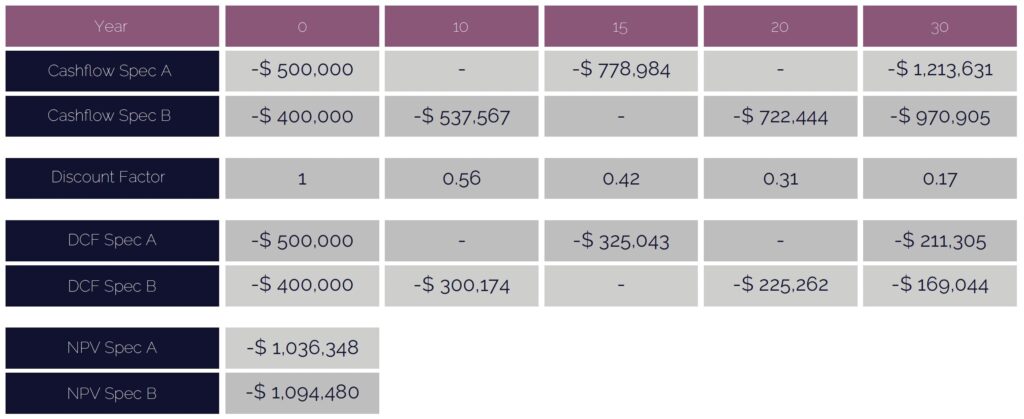
In fairness, it should be clarified that lifecycle costs represent only one half of the overall calculation. The marginal effect on rents, for example from LEED certification, must also be taken into account. Together, these will establish the overall impact on Net Present Value of different component and maintenance choices.
What are the problems?
Firstly, all too often, investment and maintenance decisions are still driven by short-term costs and revenues. The property industry often focuses on short-term capitalisation rates based on next year’s income, which frequently ignore lifecycle costs. This is partly to blame for short-term thinking. Accountancy concerns over cashflow explain some of the issue as well.
Investors who ignore lifecycle costs may overpay by a significant amount. Likewise, others who have considered lifecycle costs more carefully may find better value. This valuation uncertainty problem is made worse by insufficient data. Existing warehouses should have detailed cost records, but often they do not. Some times this is because records have not been kept accurately, but also because maintenance costs have been combined across multiple buildings. For new build, its introduction has still been hampered by the lack of accurate historical cost databases, the perceived complexity and time consuming nature of the calculations, and a potential lack of scalability when using detailed dynamic simulation tools (e.g., UMI, CityBES, UrbanOPT)[12] – but above all because investors have not required it. According to research carried out in 2022 and published the following year, an estimated half of Saudi construction projects did not employ BIM to generate accurate lifecycle costs.[13]
Secondly, investors focused on immediate profitability are not always aware of their own discount rates, let alone understand how the market values sustainability benefits such as lower energy consumption.[14] Yet the choice of discount rate is critical to accurate calculations, whether for investors or in the market valuation of energy efficient building components.
Integrating lifecycle costing into decision-making
Running an efficient warehouse requires long term planning and forecasting. Planning finances ahead of time based on when each component needs replacement prevents unexpected costs and reduces insurance risks. It also helps minimise costs. Lifecycle costing can also drive owners’ decisions, such as whether to replace conventional high-pressure mercury vapour (HPL-N) lamps with LEDs in a warehouse environment[15], the choice between active and passive solar energy, [16]or the potential benefits of restructuring warehouse space. But it is a ‘specialised task’, not conventionally performed as part of valuation and for many years generally considered as part of TDD.[17]
Conclusions
The consideration of initial costs alone is frankly a poor guide to decisions regarding warehouse components. By contrast, lifecycle costing that discounts the full projected expenditure over time is the most likely way to achieve profitable decision-making for industrial property construction, investment, and retrofit.[18] It should be a usual aspect of TDD, in warehouse purchase as in all real estate sectors. Valuations must account for true lifecycle costs, not just quick calculations. Otherwise, what the warehouse actually costs investors may be very different from its market price.
Chartered surveyors have the data and skills needed to accurately estimate lifecycle costs. Without good data, investors and lenders do not realise the costs they are likely to face. Without proper calculations, they will get the pricing wrong.
For investors, developers, and lenders, lifecycle costing is not optional anymore. It is essential for accurate valuations and smart purchasing decisions.
Getting the right analysis matters. The Built Asset Consulting team specialises in TDD, reserve fund studies and condition surveys. They help investors, developers, and lenders make informed decisions by providing accurate lifecycle cost analysis, BIM-based forecasting, and comprehensive asset valuations. Whether you are evaluating a new acquisition, planning a retrofi t, or seeking to optimise operational costs, our specialists can guide you through the process and help you avoid costly mistakes. Contact our team today to discuss how lifecycle costing can unlock true value in your property portfolio.
[1] RICS (2020, January) Technical Due Diligence of Commercial Property. https://www.rics.org/content/dam/ricsglobal/documents/standards/Technical%20due%20diligence%20of%20commercial%20property.pdf[2] Mutlu Ozturk, H., Dombayci, O. A., and Caliskan, H. (2019). Life-cycle cost, cooling degree day, and carbon dioxide emission assessments of insulation of refrigerated warehouses industry in Turkey. Journal of Environmental Engineering, 145(10), 04019062. https://doi.org/10.1061/(ASCE)EE.1943-7870.0001575
[3] Sariu, A. I., Purnawan, P., & Puspanikan, S. K., Optimization Model Design of Scrapping Cost for Asset Management Based on Cost Avoidance at PT. XYZ warehouse. Mimbar Pendidikan 10(3), 326-335. https://doi.org/10.17509/mimbardik.v10i3.88415
[4] Naujoks, F. (2026, January 13), The Hidden Capex Killer. Regulatory Drift & The Stranded Asset Trap – Why Legacy Industrial Assets are a Short Position on Environmental Law. https://doi.org/10.13140/RG.2.2.27818.68808
[5] Dell’Isola, A., and Kirk, S. J. (2003). Life cycle costing for facilities. John Wiley & Sons, p.21.
[6] Sharma, S., Kumar Gupta, A., and Gautam, C. P. (2025). Exploring the Impact of BIM on Construction Project in Reducing Life Cycle Cost. J. Inf. Syst. Eng. Manag. 10(23s) 1000-1013. https://www.jisem-journal.com/index.php/journal/article/view/8166/3703
[7] Hingst L, Dér A, Herrmann C, Nyhuis P. (2023) Towards a Holistic Life Cycle Costing and Assessment of Factories: Qualitative Modeling of Interdependencies in Factory Systems. Sustainability 15(5):4478. https://doi.org/10.3390/su15054478
[8] Kehily, D. and Underwood, J. (2017). Embedding life cycle costing in 5D BIM. Journal of Information Technology in Construction 22, 145-167. doi:10.21427/afdk-ky60
[9] Deore, M. P. J. (2023). An overview of Life Cycle Costing System. Recent Trends in Humanities, Social Sciences, 10, 93. https://acscollegeonde.ac.in/wp-content/uploads/RTHSSC-Volume-I.pdf#page=99
[10] International Standards Organisation (2024) ISO 15686-5:2017. Buildings and constructed assets — Service life planning. Part 5: Life-cycle costing. https://www.iso.org/standard/61148.html
[11] Costs are expressed in negative $
[12] Gavaldà-Torrellas, O., Monsalvete, P., Ranjbar, S., & Eicker, U. (2025). The Urban Building Energy Retrofitting Tool: An Open-Source Framework to Help Foster Building Retrofitting Using a Life Cycle Costing Perspective—First Results for Montréal. Smart Cities, 8(1), 17. https://doi.org/10.3390/smartcities8010017
[13] Alasmari E., Martinez-Vazquez P., and Baniotopoulos C. An Analysis of the Qualitative Impacts of Building Information Modelling (BIM) on Life Cycle Cost (LCC): A Qualitative Case Study of the KSA. Buildings. 2023; 13(8):2071. https://doi.org/10.3390/buildings13082071
[14] Damigos, D., Kontogianni, A., Tourkolias, C. et al. Dissecting subjective discount rates and investment literacy for energy-efficient investments. Energy Efficiency 14, 31 (2021). https://doi.org/10.1007/s12053-021-09941-4
[15] Jaya, P., and Sahroni, T. R. (2025). Enhancing Energy Efficiency in Industrial Warehouses Using Life Cycle Cost Analysis (LCCA). Advance Sustainable Science Engineering and Technology, 7(4), 0250405-0250405. https://doi.org/10.26877/asset.v7i4.2070
[16] Muthu, S.S. (2025). Life Cycle Costing: Case Studies. In: Muthu, S.S. (eds) Life Cycle Costing. Environmental Footprints and Eco-design of Products and Processes. Springer, Cham. https://doi.org/10.1007/978-3-031-94422-2_1
[17] Bienert, S., Schutzenhofer, C., Leopodsberger, G., Bobsin, K., Leutgöb, K., Hüttler, W., … & Edvardsen, D. (2010). Methodologies for integration of energy performance and lifecycle costing indicators into property valuation practice (No. D7, p. 2). Working Paper. https://immovalue.e-sieben.at/pdf/immvalue_result_oriented_report.pdf
[18] Zhang, H. (2023). Life cycle costing analysis of deep energy retrofits of a mid-rise building to understand the impact of energy conservation measures. https://arxiv.org/abs/2304.00456