



Dubai office transactions triple in value
Dubai’s office sector is defying regional turmoil as companies expand, investors deploy capital and demand for workspace outstrips supply.
First-quarter figures, which include the early weeks of the Iran conflict which began on February 28, indicate a resilient market supported by rising activity and an influx of companies establishing operations in the emirate, according to real estate advisory Cavendish Maxwell.
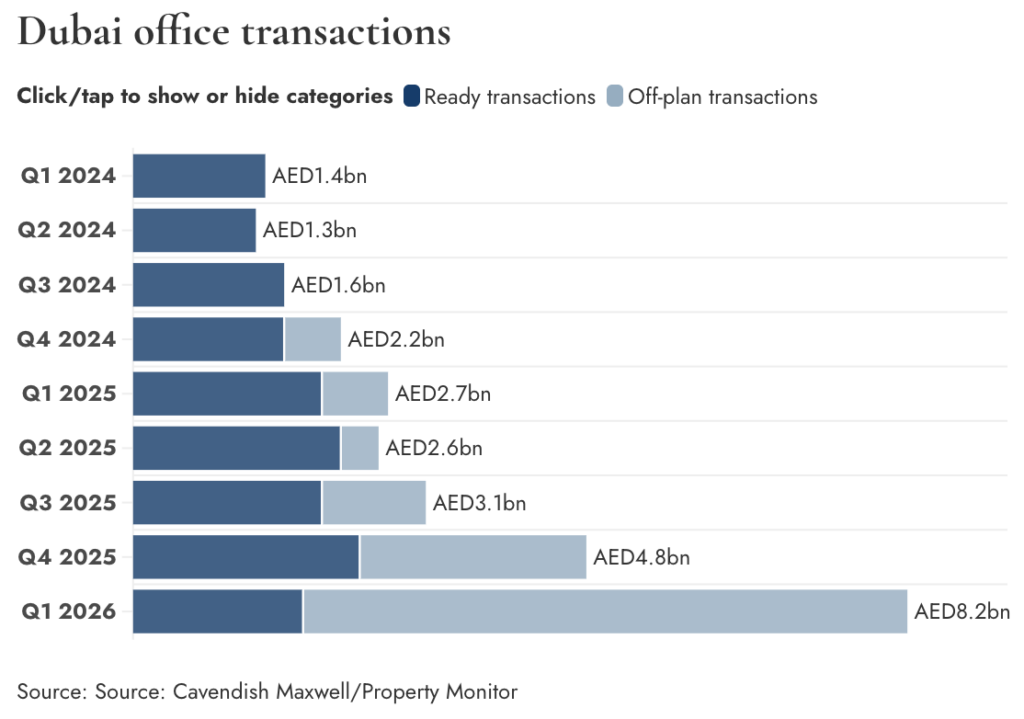
About 1,600 transactions occurred in Dubai’s office market in the first quarter worth a combined AED8.2 billion ($2.2 billion), more than triple the value recorded a year earlier. Sales prices climbed nearly a quarter year on year, while rents rose a fifth, the data showed.
Strong sales in off-plan offices, a segment that barely registered before 2026, are driving up headline figures.
January and February accounted for more than four-fifths of deal volumes. In March, when regional tensions escalated, volumes dropped more than a tenth year on year, driven by a decline in ready transactions of nearly two-thirds.
Al Sufouh 1, Business Bay and Jumeirah Lakes Towers accounted for the lion’s share of deals, with the top five locations making up more than 70 percent of all Q1 transactions. That concentration suggests where owner-occupier and investor appetite is focused.
Dubai Land Department data for April and May collated by analytics website DXB Interact shows commercial real estate transactions – offices and shops – broadly flat year-on-year at about 900. Prices, however, rose sharply, with the median climbing three quarters to around AED3.2 million and the per-square-foot rate more than doubling to AED3,600.
Vidhi Shah, director and head of commercial valuation at Cavendish Maxwell, said underlying fundamentals are intact. “Dubai’s office market is expected to remain resilient, as demand fundamentals remain in place thanks to the city’s regulatory environment, tax competitiveness and quality of infrastructure,” she said.
Dubai International Financial Centre (DIFC) registered 775 new companies in the first quarter, with March its strongest month of the three, up nearly 60 percent year on year. Similarly, Abu Dhabi’s Global Market financial free zone said last month its company registrations rose 5 percent year on year in March.
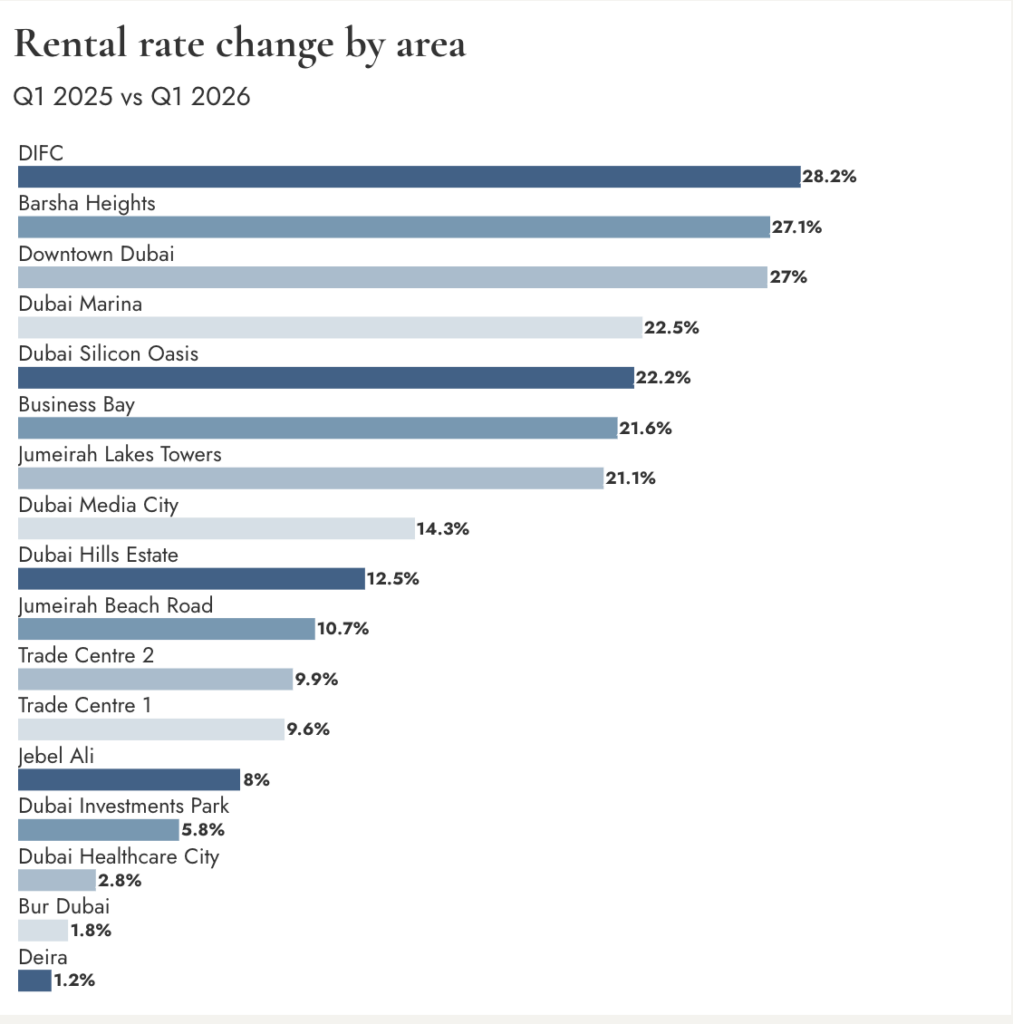
DIFC and Downtown Dubai led rental growth in Q1, up more than a quarter annually. Business Bay and Barsha Heights were not far behind. At the other end, Bur Dubai and Deira barely moved.
Supply is relatively controlled but not for long. Around 73,300sq m was delivered in Q1, including DIFC Square, a Grade A development fully pre-leased before handover. A further 240,000sq m is expected by year-end, pushing stock close to 9.7 million sq m. The pipeline then expands sharply, with total supply projected to reach 10.8 million sq m by 2028.
Cavendish Maxwell said regional tensions could cause delays through supply-chain disruption and rising material costs, though most committed projects are under construction with financing in place.
This article was originally published in Arabian Gulf Business Insights.